Mostrando entradas con la etiqueta Himalaya. Mostrar todas las entradas

sábado, 2 de abril de 2016

khardung La – The natural frontier from Himalaya to Karakorum

The road to Khardung La crosses the Ladakh granite batholith range, the western equivalent of the 2.000 km long Trans-himalayan batholith, immersed between the two suture zones dividing between Himalaya and Karakorum; the natural frontier between the two mountain ranges. South suture zone runs along the Indus valley, while North suture zone extends along the Shyok – Nubra valley…
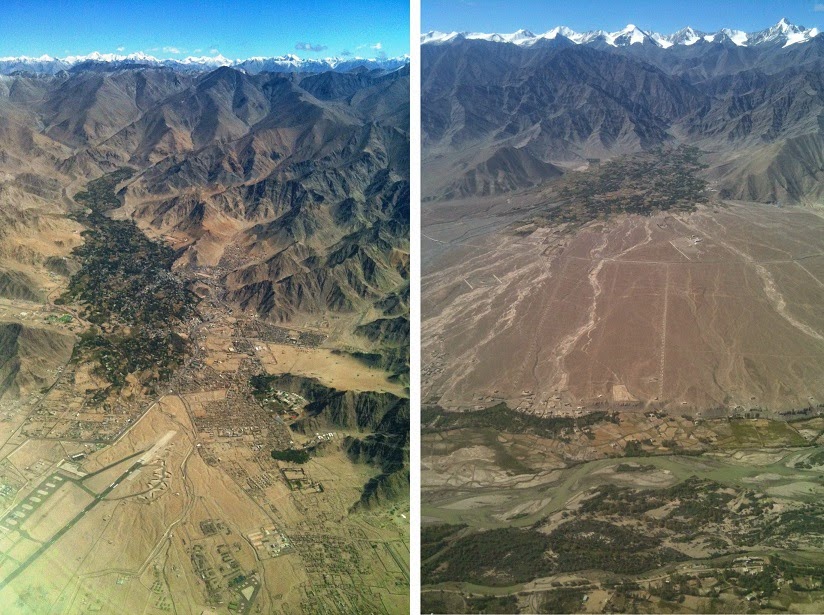
North of Leh (Left), the Khardung La road climbs from the Indus river valley to cross the Ladakh range. Karakorum is seen in the distance, beyond the Nubra valley. Amazing dejection cones extend at the foot of the Ladakh range, as a testimonial of highly active earth dynamics (Right).
Citius, altius, fortius…, the latin words are as fashionable as ever.
In modern times, society is keen for the taller, the smarter, the most beautiful. No wonder if at school, at work, at sports, at fashion and showbiz, we collectively keep looking for the record… the Queen bee.
Nature has got itself its own records too, of course. Everybody knows about Everest, the highest mountain on earth, although not the most beautiful… the longest river, the most arid desert, the fastest flying creature, the longest living tree …
Then, sometime, not that long ago, I had the opportunity to be in the highest mountain pass road in the world. A place that claims a world record. A place that people crosses for this pure and simple fact… but which is far beyond its fame.

Road to Khardung La as seen soon after leaving Leh. South of the Indus valley extend the high picks of the Himachal Pradesh Himalayas.
All along the way, here and there are found Buddhist “Gompas”, amazing monasteries hooked to the rock slopes…

Khardung La (Khardung Pass, la meaning pass in Tibetan) is a high mountain pass located in the Ladakh region of the Indian state of Jammu and Kashmir. It lies north of Leh and is the gateway to the Shyok and Nubra valleys. The elevation of Khardung La is 5,359 m, though local summit signs and dozens of stores selling shirts in Leh incorrectly claim that its elevation is in the vicinity of 5,602 m metres and that it is the world's highest motorable pass.
Curve after curve, meter after meter, road endures a franc climb to gain the 2.000 meters elevation over Leh.
Extraordinary result shape of an extreme land, this glacier valley can be seen not long before reaching the pass.   
The road, built in 1976 is strategically important to India as it is used to carry supplies to the military units  in the Siachen Glacier. It is historically important though, as it lies on the major caravan route from Leh to Kashgar in Central Asia. About 10,000 horses and camels used to take the route annually, and a small population of Bactrian camels can still be seen at Hunder, in the area north of the pass. During World War II there was an attempt to transfer war material to China through this route.
Khardung La pass, that’s it… Some snow, a modest cafeteria and plenty of colorful prayer flags… Then a lack of air, some dizzy feeling and a mind loosing walk to take this picture…
Geology and significance
Ladakh batholith granites near Khardung La pass. Highness and wind give way to a deep blue sky where colors and contrasts are dramatically beautiful.
Thick volcanics and volcano-clastics follow north of the Ladakh batholith, ranging from basalts to trachytes, together with rhyolites showing ignimbritic flow features.
As a product of the Indian collision with Asian plate, immense molasses deposits where formed as the himalayan range was rising and the Ladakh batholith was subsequently being eroded, as well as the volcanic materials associated with the alpine edge.
Not only geology… a Yak and a herder on the first pastures way down to the Nubra valley.                                                               Then, I can tell, yak milk is sweet, creamy and tasty…lovely…
The big surprising high Nubra valley, after some 6 hour drive… Azure blue waters braiding among snow white sand bars, patched here and there with greenery.
 Though a fairy landscape, heart cannot but be overwhelmed with a somehow oppressing feeling of remoteness and solitude. An unavoidable encounter with only oneself and whatever beliefs…
A Gompa in a Nubra Valley slope… Some human communion, a landscape sharing. A place to wonder about how some people are full with just a minimum, while we need so much to sometimes be quite empty…
Buddhist lamas give happy life to Gompas in the Nubra Valley as elsewhere.
Along a sharp thrust, gneisses and granites of the Karakorum overly the volcanics, followed by a conspicuous row of hot springs. Valley down, the Shyok river will eventually enter Pakistan, preventing any other valley access then the Khardung La pass.
Khardung La is widely, but incorrectly, believed to be the highest vehicle-accessible pass in the world. A well-graded Indian military road reaches 5,610 metres on the India - Tibet border. There are also higher motorable passes at Suge La, west of Lhasa, 5,430 m, and Semo La, 5,565 m, between Raka and Coqen in Central Tibet. Vehicles have also been driven over the 5,582 metres Marsimik La, in the Indian Karakoram to the north-east of Khardung La.  

sábado, 29 de agosto de 2015

On Geological Time Concept


I have recently been in the heights of the Guadarrama National Park, looking for the beautiful butterfly Graellsia Isabellae... A creature that lives only a few days ... those necessary to procreate and ensure that she and her offspring in successive years continue beautifying, briefly, her world ... and ours.

A world that in Graellsia’s case is so static, in which nothing changes, nothing happens, everything is the same, it is always night ... or it is always summer, and there are always stars in the sky...


Our own life lasts, say, hopefully, eighty years. During that time things do happen, days follow nights, seasons and even some geological phenomena occur, but nothing radical. The Guadarrama range was there when I was born and there will be when I die. The Himalayas continue their ascent and the Strait of Gibraltar is closing, but I've been watching it from Tarifa time and time again, and have not noticed any difference ....

Everest massif from the air..., Lhotse, Cho-Oyu, Makalu...

Physical time corresponding to geological time develops with a slowness that, unlike not just historical time, but own-self time, rather than making seconds, minutes or days to be important, years, centuries and millennia are important.

Earth life resumed in 24 hours

Geology, to the extent that it is a historical science, has in the "time" one of its basic concepts. Its presence is more or less explicit, in the treatment of all geological processes and arguably to have a basic understanding of the science claims to have built the concept of geological time.

Therefore, the importance that the Geological Time subject has in the internal logic of the geological science, along with its difficult conceptualization, justifies its didactic interest. However, didactic treatment of the geologic time is often limited to addressing the difficulty, evident on the other hand, that mental representation offers of such unimaginably great times..
Indeed, the difficulties of magnitude hinder or prevent the construction of the concept of geological time, particularly :
The " imaginative barrier " or difficulty to mentally represent such enormous magnitudes as those involved in geologic time and, 
The slowness, considered from a human time scale, of
most occurring geological processes

Other additional difficulties have to do with the huge spatial and not only temporary scales involved in many of the geological processes, inaccessibility to which these processes occur, the temporal distance between cause and effect and its uniqueness and impossibility to be reproduced in the laboratory.
 Strait of Gibraltar as seen from spanish side

Geological time is but a portion of physical time, the last 4,550 million years, where it makes no sense speaking of the first as a qualitatively different concept from the second.

Ordesa glacial valley, in the Pyrenees (Spain)

The construction of the concept of geological time, to understand the magnitude of the numbers involved, requires first to associate a concept of change. If the Earth is constantly changing, each geological period is likely to be characterized as distinct from the earlier and later. 

In addition, in order to reconstruct the past of the Earth it is not only necessary that changes have occurred but it is essential that terrestrial dynamics have left some kind of remains or evidence of those changes.

In this sense, until the nineteenth century, the teleological and anthropocentric position of the Earth, considered the abode of humanity, left no sense to the existence of a land without men. The concept of an Earth without men was a very important change that was not easy to perform. In the absence in the nature of elements that allow inferring the age of the Earth, it only remained to interpret historical documents and the Bible was not only considered a sacred text for the Christian doctrine, but was generally accepted as the most reliable historical document for earlier periods. 

Genesis was resorting to the more necessary because it lacked alternative. It is not so surprising Archbishop James Ussher dating the creation of the world at 9 pm on October 23 4004 BC.

In the nineteenth century Buffon estimated the time needed to consolidate the planet 117,000 years, while the total time to get the current temperature would be three million years ... These numbers may seem ridiculous now, but eventually meant a long shot that broke the barrier set by the still dominant biblical chronology and, above all, meant that the age of the Earth could be scientifically calculated.

In the second half of the nineteenth century a number of proposals would happen that aimed to put figures to the age of the Earth. One was due to Darwin, who attributed the age of 300 million years in southeast England, this being taken by others as the "new standard" on the age of the Earth.

But the most influential of these in the second half of the nineteenth century was due to Lord Kelvin, who started from the hypothesis of a land formed by the collision of meteorites that as a result of these impacts, should have been found melted in full. 

From then until now, the planet would have been continually losing heat. In 1868, after some less precise proposals for the Earth he established an approximate age of 100 million years. This figure remained a point of reference for the rest of the century.


Sorrosal cascade spot, Huesca (Spain)

We will not extend here in the further evolution of earth sciences, currently however the age considered for the Earth is more than 4500 million years. That would be today the length of Geological Time for our planet.

Tomorrow, geological time can refer to the geo-planetology and spread in who knows how many billions of years.

El Tiempo Geológico


He estado recientemente buscando a la bella mariposa Graellsia Isabellae en los altos del Parque Nacional del Guadarrama… Una mariposa nocturna que vive unos pocos días…, los justas para procrear y asegurar que ella y su descendencia  en sucesivos años sigan embelleciendo, fugazmente, su mundo… o el nuestro.

Un mundo que en su caso dura solo unos pocos días… un mundo por tanto estático, en el que nada cambia, nada pasa, todo es igual, siempre es de noche… o siempre es verano, o siempre hay estrellas…


Nuestra vida dura, digamos, ojalá, ochenta años. En ese tiempo sí pasan cosas, días y noches, estaciones e incluso algunos fenómenos geológicos, pero nada radical. El Guadarrama estaba ahí cuando nací y ahí seguirá cuando me muera. Los Himalayas siguen su ascenso y el estrecho de Gibraltar se va cerrando, pero mira que he ido veces a Tarifa y no noto la diferencia… En cambio, las bases topográficas que utilizamos en un túnel en construcción en Nepal se han desplazado hasta dos metros después del terremoto de abril… ahí es nada.

Macizo del Everest, desde el aire..., Lhotse, Cho-Oyu, Makalu...

El tiempo físico que corresponde al tiempo geológico se desarrolla con una lentitud en la que a diferencia no ya del tiempo histórico, sino del tiempo personal, en vez de ser importantes los segundos, minutos o días, son importantes los años, los siglos y los milenios.

La edad de La Tierra resumida en 24 horas

La geología, en la medida en que es una ciencia histórica, tiene en el «tiempo» uno de sus conceptos básicos. Su presencia se halla, más o menos explícita, en el tratamiento de todos los procesos geológicos y podría decirse que tener unas nociones básicas de esta ciencia exige haber construido el concepto de Tiempo Geológico.

Por lo tanto, la importancia que, desde la lógica interna de la ciencia de la geología, tiene el tema del Tiempo Geológico, junto con la difícil conceptualización que presenta, justifican su interés didáctico  Sin embargo, el tratamiento didáctico del tiempo geológico se limita con frecuencia a abordar la dificultad, por otro lado evidente, que ofrece la representación mental de tiempos tan inimaginablemente grandes.

En efecto, las dificultades de magnitud obstaculizan o impiden la construcción del concepto de Tiempo Geológico, sobre todo:
La «barrera imaginativa» o dificultad de representar mentalmente cifras de tan enorme magnitud como las implicadas en el Tiempo Geológico y,
La lentitud, considerada desde la escala temporal humana, con que ocurren la mayor parte de los procesos geológicos.

Otras dificultades añadidas tienen que ver con las enormes escalas espaciales y no sólo temporales implicadas en muchos de los procesos geológicos, la inaccesibilidad a la que dichos procesos ocurren, la lejanía temporal entre causa y efecto y su singularidad e imposibilidad de reproducirlos en el laboratorio.
 El estrecho de Gibraltar visto desde España

El Tiempo Geológico no es más que una porción del tiempo físico, los últimos 4.550 millones de años, careciendo de sentido hablar del primero como si se tratase de un concepto cualitativamente diferente del segundo.

El valle glaciar de Ordesa, en los Pirineos

La construcción del concepto de Tiempo Geológico, para entender la magnitud de las cifras implicadas, requiere en primer lugar asociarle un concepto de cambio. Si la Tierra está en permanente cambio, cada período geológico es susceptible de ser caracterizado, diferenciándolo de los anteriores y posteriores. 

Además, para poder reconstruir el pasado de la Tierra, no sólo es necesario que hayan ocurrido cambios sino que resulta imprescindible que la dinámica terrestre haya dejado algún tipo de restos o evidencias de esos cambios.

En este sentido, hasta entrado el siglo XIX, la posición teleológica y antropocéntrica de la Tierra, considerada como la morada de la humanidad, dejaba sin sentido la existencia de una Tierra sin hombres que la poblasen. La concepción de una Tierra sin hombres supuso un cambio muy importante que no resultó fácil de realizar.  Ante la ausencia en la naturaleza de elementos que permitieran inferir la antigüedad de la Tierra, sólo restaba interpretar los documentos históricos y la Biblia no sólo era considerada como un texto sagrado para la doctrina cristiana, sino que se aceptaba generalmente como el documento histórico más fiable para los períodos más antiguos. 

Recurrir al Génesis era tanto más necesario cuanto que se carecía de alternativa. No es de extrañar así  la datación del arzobispo James Ussher, que situaba la creación del mundo a las 9 horas del 23 de octubre del año 4004 aC.

En el siglo XIX Buffon calcula el tiempo necesario para la consolidación del Planeta en 117.000 años, mientras que la duración total para tener la temperatura actual sería de tres millones de años… Estas cifras pueden parecernos ridículas en la actualidad, pero en su momento significaron una apuesta arriesgada que rompía la barrera establecida por la cronología bíblica, aún dominante y, sobre todo, implicaban que la edad de la Tierra podía ser calculada científicamente.

En la segunda mitad del siglo XIX se suceden diversas propuestas que tienen como objetivo poner cifras a la edad de la Tierra. Una de ellas se debe a Darwin, quien atribuyó al sureste de Inglaterra la edad de 300 millones de años que fue tomada por otros autores como la «nueva referencia» sobre la edad de la Tierra.

Pero la datación más influyente de las realizadas en la segunda mitad del siglo XIX se debe a Lord Kelvin, quien partió de la hipótesis de una Tierra formada por el choque de meteoritos que, como consecuencia de esos impactos, debería haberse encontrado fundida en su totalidad. Desde ese momento y hasta la actualidad, el Planeta habría ido perdiendo continuamente calor.  En 1868, tras algunas propuestas menos precisas, estableció para la Tierra una edad aproximada de 100 millones de años. Esta cifra permaneció como referencia obligada durante el resto del siglo.


Cascada de Sorrosal, Huesca


No nos vamos a extender más aquí en la evolución posterior de las ciencias de la tierra, sin embargo actualmente la edad considerada para la tierra es de algo más de 4500 millones de años. Esa sería a día de hoy la duración del Tiempo Geológico de nuestro planeta.

Mañana, el tiempo geológico puede referirse a la geo-planetología y extenderse en quien sabe cuántos miles de millones de años.
Related Posts Plugin for WordPress, Blogger...